Come along with me on a provocative journey.
For the purposes of this journey, you are the Traveler. You represent any one of us who has awakened inside existence and begun asking questions about what this strange experience of being human actually means. You bring with you everything a human being brings: memories, beliefs, fears, hopes, inherited assumptions, experiences, and questions.
I will be the Guide. I am not standing outside the mystery with the answers. I am inside it with you. My purpose is simply to walk beside you, open the doors we encounter, explain something of what humanity has discovered behind them, and occasionally ask whether what we find changes the way we understand the Hall.
Neither of us built this place.
Neither of us knows everything that lies beyond it.
We are exploring it together.
“Where are we?” you ask.
“Look around,” I reply.
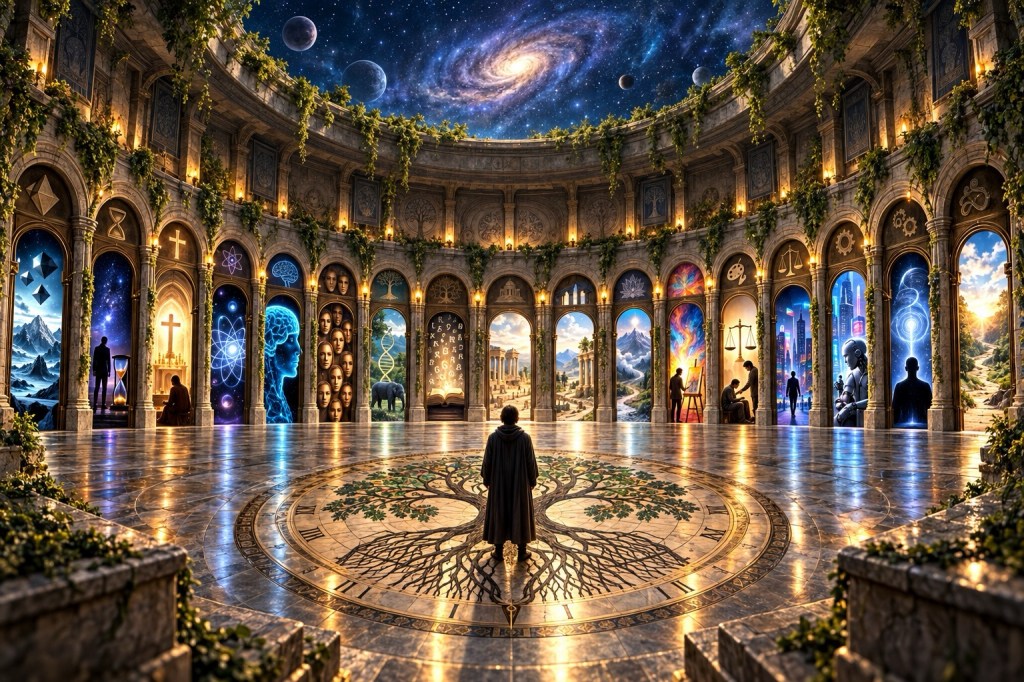
Imagine humanity awakening inside a vast circular chamber. Its walls are ancient stone, weathered by centuries of touch. Moss fills the cracks. Names, symbols, equations, prayers, poems, and fragments of forgotten languages have been carved into the walls by those who came before us. Some inscriptions contradict others. Some have been chiseled away. Some remain unfinished.
Above us, the ceiling disappears into darkness.
At the center of the floor lies an enormous mosaic: a clock face intertwined with the spreading branches and roots of the Tree of Life. The hands of the clock move almost imperceptibly, yet no one who enters the chamber can stop them.
You look down at the slowly moving hands.
“What is this place?”
“This,” I tell you, “is the Hall of Finitude.”
You study the enormous walls surrounding us. “It sounds like a prison.”
“It is not a prison,” I reply. “It is the condition of being human.”
We begin walking.
I explain that every human being enters this Hall without choosing the circumstances of entry. We do not choose our century, culture, language, body, family, geography, or inherited worldview. We awaken already surrounded by interpretations. Before we possess the ability to question reality, someone has already begun naming reality for us.
“This is good.”
“That is bad.”
“This is God.”
“That is nature.”
“This is truth.”
“That is superstition.”
“This is normal.”
“That is impossible.”
You stop walking and look more carefully at the inscriptions covering the walls.
“So these were here before I arrived?”
“Most of them,” I say. “And that is important.”
Long before a child becomes a philosopher, scientist, theologian, mystic, atheist, skeptic, or believer, the walls of the Hall have already begun acquiring meaning. Parents write upon them. Religion writes upon them. Culture writes upon them. Teachers, friends, governments, books, fears, experiences, successes, failures, and eventually the internet and social media all add their inscriptions.
The Hall we inherit gradually becomes the Hall through which we interpret everything else.
“But if the walls are already covered with other people’s ideas,” you ask, “how can I know what is actually real?”
I smile.
“That may be the question that begins the entire journey.”
We continue walking.
“The strange gift of being human,” I tell you, “is that eventually we can notice the walls.”
You look at me.
“What do you mean?”
“We become capable of recognizing that what we were taught about reality and reality itself may not be exactly the same thing.”
Something changes when that recognition occurs.
We discover that our senses occupy only a narrow range of what exists. We recognize that our lifespan is brief, our knowledge incomplete, our language imperfect, and our interpretations conditioned by biology, culture, personal experience, and history. We begin to understand that the reality presented to consciousness is not necessarily the whole of Reality.
You run your hand across one of the ancient inscriptions.
“So we are limited.”
“Profoundly.”
“Then how can we ever understand anything?”
“That is where the story becomes interesting,” I reply. “Because the creature capable of recognizing its limitation has already done something remarkable.”
A finite being has become aware of finitude.
You look around the chamber again, but now differently.
The walls have not moved. The inscriptions have not disappeared. The clock continues turning beneath our feet.
Yet something has changed.
You have noticed them.
And once that happens, doors begin appearing in the walls.
We approach the first.
I place my hand against the ancient wood.
“Each door represents a different way humanity has tried to understand the reality in which it awakened,” I explain. “Philosophy, theology, physics, neuroscience, psychology, evolution, language, history, mysticism, art, ethics, technology, and consciousness have all approached the mystery from different directions.”
Art does not replace evidence. It performs a different function. It expands the range of what we can perceive, feel, and imagine. It can make another person’s inner world accessible. It can challenge the stories that imprison us.
“Which door contains the truth?” you ask.
Ethics begins when we recognize that our actions affect beings beyond ourselves. It examines harm, justice, freedom, responsibility, dignity, compassion, rights, and the conditions under which a life can flourish.
“That is exactly what we are going to find out.”
I pause before opening it.
“But there is one condition.”
“What?”
“We must resist the temptation to decide beforehand which door is allowed to be right.”
You glance around the circular Hall.
“So we enter all of them?”
“All fourteen.”
“And then?”
“Then we return to the center.”
You look toward the Tree of Life embedded within the great clock.
“What is at the center?”
“For now,” I say, “nothing.”
You stare at me suspiciously.
“Nothing?”
“Nothing we are ready to see yet.”
I open the first door.
And our tour of the Hall of Finitude begins.
Door One: Philosophy — The Door of Questions
The first room is quiet.
There are no machines, temples, laboratories, or instruments. Only a stone floor, a low table, and a single lamp burning without visible fuel. Around the walls are questions rather than answers.
What is real?
What can be known?
What is a self?
What is freedom?
What makes a life meaningful?
You read them slowly.
“So this door does not tell us what reality is.”
“Not directly,” I say. “It teaches us to examine the assumptions hidden inside the question.”
Philosophy begins when inherited certainty becomes insufficient. It does not necessarily reject tradition, religion, science, or common sense. It asks what each one means, what it presupposes, and whether its conclusions follow from its premises.
At the center of the room stands a mirror.
You look into it and see yourself, but the reflection is surrounded by faint outlines of other faces: parents, teachers, ancestors, strangers, and people whose ideas have shaped you without your knowing.
“The philosophical mirror,” I explain, “reveals that the mind is never as independent as it imagines. We think we are asking questions freely, but our questions are often inherited. Even rebellion can be inherited.”
You study the mirror.
“Then philosophy cannot free me completely.”
“No. But it can show you where the chains are.”
The room teaches us intellectual humility. Every answer creates new questions. Every system illuminates some features of reality while obscuring others. Philosophy does not always lead to certainty. Often, it leads to a more disciplined uncertainty.
Before we leave, you ask, “Is uncertainty a failure?”
“Not when the alternative is false certainty.”
The lamp flickers.
The first door closes behind us.
Door Two: Theology — The Door of Meaning
The second door opens into a chamber filled with symbols.
There are altars, prayer wheels, candles, sacred texts, icons, geometric diagrams, and empty spaces where images have deliberately been forbidden. Different traditions stand side by side, not identical, but all reaching toward something beyond ordinary human limitation.
“What does this room claim?” you ask.
“That existence may not be meaningless,” I reply. “That reality may possess depth, intention, value, or sacred significance.”
Theological traditions differ profoundly. Some speak of a personal Creator. Some speak of an impersonal absolute. Some describe reality as a field of consciousness, a cosmic order, a sacred unity, or an unfolding mystery. Some insist that the ultimate cannot be represented at all.
The room is not a museum of identical beliefs. It is a record of humanity’s attempts to relate to what exceeds human control.
You point toward the ceiling.
“Does this door prove that God exists?”
“No. It shows that the question of God has shaped human consciousness more deeply than almost any other question.”
Theology offers narratives of origin, purpose, suffering, morality, death, and hope. It can inspire compassion, courage, sacrifice, and reverence. It can also become rigid, coercive, and hostile to questioning when symbols are mistaken for the reality they represent.
At the far end of the room is a narrow window. Beyond it lies a darkness filled with stars.
You look through it.
“Why does the room contain both certainty and mystery?”
“Because every theology lives between them. It speaks about the ultimate while knowing, at least in its wiser forms, that the ultimate cannot be contained by speech.”
You ask whether faith is belief without evidence.
“Sometimes,” I say. “But faith can also mean trust, orientation, commitment, or a willingness to live in relation to what cannot be fully proven.”
The room leaves us with a difficult possibility: meaning may be discovered, created, received, or projected. We cannot settle that question merely by wanting one answer to be true.
As we leave, one inscription catches your eye:
The map is not the sacred landscape.
Door Three: Physics — The Door of Structure
The third door is made of polished metal.
Beyond it, the Hall becomes almost impossibly vast. Galaxies turn in darkness. Fields ripple through empty space. Particles appear as probabilities rather than tiny objects. Time stretches, bends, and refuses to behave like the simple sequence we experience.
You take a step forward.
“This is not the world I see.”
“It is the world your ordinary senses simplify,” I say.
Physics reveals that common experience is not a complete description of reality. Matter is not as solid as it appears. Space and time are not as absolute as they seem. At the smallest scales, nature is described through mathematical relationships that challenge ordinary intuition.
The room contains no obvious observer. Yet every instrument, equation, and measurement is connected to an act of observation.
“Does physics describe reality,” you ask, “or only what can be measured?”
“That distinction matters.”
Physics is extraordinarily powerful because it produces precise predictions and technologies that work. But its success does not automatically answer every human question. It can describe patterns, structures, transformations, and relationships without telling us why there is something rather than nothing, whether existence has meaning, or what consciousness ultimately is.
You watch a star collapse into a black hole.
“Does physics eliminate mystery?”
“Quite the opposite. It often relocates mystery to a deeper level.”
The room teaches us that reality may be stranger than imagination, but also that strangeness is not the same as proof of every extraordinary claim. Wonder must remain disciplined by evidence.
Before we leave, the metal wall becomes transparent.
Behind it, the entire Hall appears as a pattern of energy, geometry, and motion.
Then the image vanishes.
Door Four: Biology and Evolution — The Door of Becoming
The fourth door opens into a living landscape.
Cells divide in pools of light. Roots push through soil. Fish move through ancient water. Limbs emerge, disappear, and reappear in altered forms. Creatures struggle, adapt, reproduce, cooperate, compete, and die.
“This room tells the story of how life changes,” I say.
Evolution reveals that human beings are not separate from the living world. We are descendants of ancient organisms shaped by variation, inheritance, selection, cooperation, contingency, and environmental pressure.
You watch a human hand form from structures that once belonged to distant ancestors.
“So I am an animal.”
“Yes.”
The statement sounds simple, but it has consequences. Our emotions, instincts, social behavior, fears, desires, and cognitive tendencies have biological histories. The mind did not arrive in the world untouched by evolution. It was shaped for survival, not necessarily for perfect truth.
“Then can I trust my thoughts?”
“Enough to investigate, not enough to worship.”
Evolution does not imply that everything is meaningless or that human beings are worthless. It shows that complexity can emerge without conscious design at every stage. It also reveals that life is both fragile and astonishingly creative.
At the center of the landscape, two forces grow around one another: competition and cooperation.
“Which one is the true engine of life?” you ask.
“Both. And neither is sufficient alone.”
Life survives through conflict, symbiosis, adaptation, sacrifice, and interdependence. The individual is real, but never entirely separate from the systems that sustain it.
The room leaves us with a humbling insight: we are temporary expressions of a process far older than ourselves.
Door Five: Neuroscience — The Door of the Brain
The fifth door opens into a chamber of light.
Networks of neurons flash across the walls. Memories form and dissolve. Emotions alter perception. Decisions begin before conscious awareness reports having made them. The brain appears less like a single command center and more like a living society of interacting processes.
You watch a thought arise.
“Where did that come from?” you ask.
“From many places at once.”
Neuroscience shows that experience depends deeply on the brain. Injury can alter personality. Chemicals can change mood. Electrical stimulation can produce sensations, memories, and impulses. Sleep, trauma, attention, and expectation can reshape the world as it appears to us.
“So consciousness is just the brain?”
“That is one interpretation. It is not yet a complete explanation.”
The brain clearly participates in consciousness, but the existence of neural correlates does not by itself explain why experience feels like anything from the inside. We can map activity associated with pain, color, memory, or self-awareness, yet the subjective quality of experience remains difficult to reduce to description.
You place your hand over your chest.
“If my brain changes, I change.”
“Almost certainly.”
“Then what part of me is permanent?”
The room offers no answer.
Instead, it shows you that the self may be a dynamic pattern: embodied, remembered, socially shaped, and continuously reconstructed. This does not make you unreal. A wave is real even though it is not separate from the water.
The final image in the room is a brain observing a model of itself.
The model turns and observes the brain.
Neither can find the first observer.
Door Six: Psychology — The Door of the Inner World
The sixth door opens into a house with countless rooms.
In one room, a child hides beneath a table. In another, an adult repeats a pattern they swore they would never repeat. In another, a person stands before a crowd wearing a face that does not feel like their own.
“This is the architecture of the inner world,” I explain.
Psychology explores perception, memory, emotion, motivation, attachment, trauma, identity, behavior, and the unconscious processes that influence us without appearing in consciousness.
You enter a room filled with mirrors. Each mirror shows a different version of you: the person you believe yourself to be, the person others expect you to be, the person you fear you are, and the person you might become.
“Which one is real?” you ask.
“All of them reveal something. None is complete.”
Psychology teaches that human beings are not always transparent to themselves. We rationalize after deciding. We defend identities we did not consciously choose. We mistake familiarity for truth and emotional intensity for importance.
But psychology also reveals the possibility of change. Patterns learned in one environment can be examined, interrupted, and transformed. Awareness does not guarantee freedom, but it creates the possibility of choice.
At the center of the house is a locked room.
“What is inside?” you ask.
“Everything you have not yet been willing to know about yourself.”
You reach for the handle, then stop.
“Must I open it?”
“Not all at once.”
The door remains closed, but a small crack appears beneath it.
Light enters the hallway.
Door Seven: Language — The Door of Names
The seventh door is covered with words.
Every object in the room bears several names. A stone is called sacred by one person, ordinary by another, evidence by a scientist, a weapon by a soldier, and a memory by a child who found it beside a river.
“Language does not merely describe the world,” I tell you. “It helps construct the world we inhabit.”
Words divide continuous experience into categories. They allow us to communicate, remember, plan, teach, and cooperate. But they also create boundaries that can appear more absolute than they are.
You point to the word “self.”
“What does this name refer to?”
“That depends on what you believe a self is.”
Language can reveal distinctions, but it can also conceal them. It can preserve wisdom and transmit prejudice. It can make invisible experiences speakable, or make living realities seem like abstract objects.
At the center of the room is a silent figure.
You ask, “Why is it silent?”
“Because some experiences are damaged when forced into words.”
The figure gestures toward the walls. The inscriptions rearrange themselves depending on which language you read them in.
“Does that mean truth is only language?”
“No. It means our access to truth is mediated by language more often than we realize.”
The room teaches us to listen for what words point toward without confusing the pointing finger with the destination.
Door Eight: History and Culture — The Door of Inheritance
The eighth door opens into a corridor of generations.
Empires rise and fall. Families migrate. Languages merge. Borders harden and dissolve. Technologies transform daily life. Stories are preserved, revised, weaponized, and forgotten.
“This is the room of inheritance,” I say.
No person enters the Hall alone. We arrive inside histories already in motion. Our identities are shaped by events that occurred before our birth: wars, migrations, discoveries, injustices, revolutions, religious movements, economic systems, and cultural memories.
You see your own life connected to thousands of invisible threads.
“So much of me began before me.”
“Yes.”
History teaches that the present is not inevitable. The institutions and assumptions surrounding us were made by people, which means they can be changed by people. But history also warns us that good intentions do not prevent unintended consequences.
At the center of the corridor are two doors. One is labeled Progress. The other is labeled Decline.
“Which one is history moving toward?” you ask.
“Neither are in a straight line.”
Humanity can become more knowledgeable while remaining cruel. It can become more technologically capable while becoming more spiritually confused. It can expand rights in one generation and destroy them in another.
The room asks us to inherit the past without becoming imprisoned by it.
Before leaving, you see an inscription scratched into the floor:
Remembering is not the same as repeating.
Door Nine: Mysticism and Contemplation — The Door of Direct Experience
The ninth door opens into darkness.
There are no explanations here. No diagrams. No arguments. No competing systems. Only silence, breath, attention, and the gradual weakening of the boundary between observer and observed.
You become uncomfortable.
“Where is the information?”
“Perhaps this room is asking what remains when information stops.”
Mystical and contemplative traditions explore direct experience: meditation, prayer, silence, surrender, awe, unity, emptiness, presence, and the transformation of the sense of self.
Some experiences are interpreted as contact with God. Others as insight into consciousness, the dissolution of ego, or the recognition of interdependence. The interpretations vary, but the experiences can be psychologically and ethically significant.
You close your eyes.
For a moment, the distinction between your breathing and the air around you becomes less certain.
“Is this proof of something beyond the self?” you ask.
“It may be evidence of a profound experience. Whether it proves a metaphysical conclusion requires further judgment.”
The room teaches caution as well as openness. Not every extraordinary experience is a revelation. Some are products of the brain, culture, expectation, or altered states. Yet reducing every experience to its mechanism may also fail to capture its meaning.
When we leave, the darkness does not disappear.
It follows us as a quiet depth beneath the other rooms.
Door Ten: Art and Imagination — The Door of Possibility
The tenth door opens into a gallery that is constantly changing.
Paintings become music. Music becomes movement. Movement becomes story. Stories become worlds in which impossible choices reveal real emotions.
“This room does not ask only what is true,” I say. “It asks what could be true, what might be felt, and what has not yet been imagined.”
Art allows human beings to encounter realities that cannot be reduced to propositions. It gives form to grief, longing, beauty, terror, love, absurdity, and hope. It can reveal what ordinary language hides.
You stand before a painting of the Hall itself. In the painting, the walls are transparent, and every person inside is connected by threads of light.
“Is this true?” you ask.
“Not necessarily as a scientific description. But it may express a truth about human interdependence.”
At the center of the gallery is an unfinished sculpture.
“What is it?”
“Your life,” I reply.
You look at the empty spaces.
“Who finishes it?”
“No one entirely. But you are responsible for what you add.”
Door Eleven: Ethics — The Door of Responsibility
The eleventh door opens into a room divided by a narrow bridge.
On one side are human beings suffering from hunger, violence, loneliness, and neglect. On the other side are people with power, comfort, knowledge, and the ability to respond.
“This room asks what we owe one another,” I explain.
You look across the bridge.
“Can morality exist without God?”
“Some believe it cannot. Others ground morality in reason, empathy, human flourishing, social cooperation, or the intrinsic value of conscious life.”
The room does not settle the foundation of morality, but it makes one fact difficult to ignore: whatever our metaphysical beliefs, suffering is experienced by someone.
At the center stands a scale. On one side is intention. On the other is consequence.
“Which matters more?” you ask.
“Both. And neither is enough alone.”
Good intentions can cause harm. Good outcomes can arise from terrible motives. Ethical life requires attention, humility, accountability, and a willingness to revise our behavior when reality contradicts our self-image.
The bridge is narrow because responsibility is difficult. But it is also the only path connecting knowledge with action.
As we cross, the room grows brighter.
Door Twelve: Technology — The Door of Extension
The twelfth door opens into a city of machines.
Tools extend the hand. Writing extends memory. Telescopes extend sight. Computers extend calculation. Networks extend communication. Artificial intelligence extends pattern recognition. Biotechnology extends the ability to alter life itself.
“Technology is not merely a collection of objects,” I say. “It is a way of extending human capacities.”
You watch people build machines that imitate aspects of thought.
“Will technology free us from the Hall?”
“It may change the Hall. It will not necessarily free us from being human.”
Every tool amplifies both intention and error. Technology can heal, connect, educate, and liberate. It can also surveil, manipulate, isolate, and destroy. The question is never only what a tool can do, but who controls it, what values guide it, and what consequences it creates.
At the center of the city is a machine surrounded by mirrors. It reflects the desires of whoever stands before it.
“So technology shows us ourselves.”
“Very often.”
The danger is not that machines become powerful. The danger is that human beings become powerful without becoming wiser.
Before leaving, you see a warning engraved above the exit:
Capability is not the same as wisdom.
Door Thirteen: Death and Finitude — The Door of the Clock
The thirteenth door is cold.
Inside, the great clock from the center of the Hall is repeated in countless forms. Every clock is moving. None can be stopped.
You understand immediately.
“This is the room we avoid.”
“Yes.”
Death is not merely an event at the end of life. Awareness of death shapes priorities, institutions, religions, relationships, art, fear, courage, and meaning. Finitude gives time its urgency. It makes choices irreversible and moments precious.
You watch a human life appear as a brief line of light.
“That is all?”
“That is all we can see from here.”
The room does not tell us whether consciousness continues after death. It presents the uncertainty honestly. Some traditions promise continuation. Some deny it. Some suspend judgment. Science can describe the biological processes of dying but has not resolved every philosophical question surrounding consciousness and personal identity.
You ask, “How should I live if I do not know what comes after?”
“By taking seriously what you do know.”
You know that others can suffer. You know that love can be lost. You know that your actions shape lives. You know that time passes whether or not you are prepared.
The clock does not demand despair.
It demands attention.
When we leave, you look back at the door.
“Why does this room feel more alive than the others?”
“Because finitude makes every other room matter.”
Door Fourteen: Consciousness — The Door of the Inner Light
The fourteenth door is unlike the others.
It has no handle.
It opens when you stop trying to force it.
Beyond it is a room without walls. There is no clear boundary between inside and outside, observer and observed, thought and awareness. Experiences arise and pass like weather across an open sky.
You become aware of the fact that you are aware.
“This is the room from which I have been seeing all the others,” you say.
“Perhaps.”
Consciousness is the condition through which every door becomes present. We can study its neural correlates, evolutionary history, psychological structures, linguistic expressions, and philosophical implications. Yet the immediate fact of experience remains irreducible in a way that continues to challenge every complete theory.
You ask, “Am I the consciousness?”
“I do not know whether consciousness is something you possess, something your brain produces, something reality expresses through you, or something more fundamental than either of us understands.”
The room does not offer a final doctrine. It offers a reversal.
Until now, you have treated consciousness as a window through which you observe the Hall.
Now you begin to wonder whether the Hall, as experienced, is inseparable from the window.
The walls, inscriptions, doors, and clock are not denied. But their appearance depends upon awareness. Without consciousness, there may still be a world. Yet the world as lived, interpreted, valued, feared, and loved exists only in relation to experience.
You look toward me.
“Is this the final door?”
“No.”
You are startled.
“There are fourteen doors,” you say.
“Yes. But the fourteenth door has shown us something important. The one who enters the doors is also part of the mystery.”
We return to the circular Hall.
The doors close one by one behind us.
Philosophy has taught us to question.
Theology has taught us to seek meaning.
Physics has revealed hidden structure.
Evolution has shown us our continuity with life.
Neuroscience has exposed the dependence of mind upon brain.
Psychology has revealed the complexity of the inner world.
Language has shown us how names shape reality.
History has revealed the inheritance surrounding every self.
Mysticism has opened the possibility of direct encounter.
Art has expanded imagination.
Ethics has made responsibility unavoidable.
Technology has extended human power.
Death has given urgency to time.
Consciousness has turned the question back upon the questioner.
We stand again at the center of the Hall.
The clock is still moving.
The Tree of Life still spreads across the floor.
But now the mosaic has changed.
The branches are no longer separate from the clock. The roots pass through the numbers. The hands move through the branches. Every door is connected to every other door by lines of light.
You look at me.
“So which door was right?”
“Each one revealed something real.”
“But none revealed everything.”
“Exactly.”
You walk around the mosaic.
“Then the truth is divided among the doors?”
“Perhaps. Or perhaps the doors are divided only because human beings need different approaches to what cannot be contained by one approach.”
You kneel beside the Tree of Life.
The roots descend into darkness. The branches rise toward the unseen ceiling. Between them, countless forms of life appear and disappear.
“What is the Tree?” you ask.
“It is existence as relationship.”
“And the clock?”
“Existence as change.”
You place your hand on the center of the mosaic.
“What is the Hall, then?”
“The Hall is the world as encountered by finite consciousness: inherited, interpreted, measured, imagined, valued, feared, and transformed.”
You look toward the walls.
The inscriptions are still there, but they no longer appear to be a single authoritative account. They are fragments of a collective attempt to understand.
Some are beautiful.
Some are dangerous.
Some are incomplete.
Some contradict one another because they were written from different rooms.
You ask, “If no door contains the whole truth, how do I know what to believe?”
I answer carefully.
“Believe provisionally. Investigate honestly. Remain open to correction. Distinguish experience from interpretation, evidence from desire, metaphor from mechanism, and mystery from permission to claim anything.”
You consider this.
“That sounds less satisfying than certainty.”
“It is less comforting. It may also be more faithful to reality.”
The clock continues moving.
A sound rises from beneath the floor.
At first it resembles wind. Then water. Then breathing.
The center of the mosaic begins to open.
You step back.
“What is happening?”
“The final outcome.”
The opening is not a hole. It is a mirror, but not one that reflects your body. It reflects every perspective we have encountered.
You see yourself as an animal, a mind, a story, a body, a memory, a moral agent, a historical inheritance, a biological process, a witness, a creator, and a temporary pattern in time.
Then the images begin to overlap.
The animal is not separate from the mind.
The mind is not separate from the body.
The body is not separate from evolution.
Evolution is not separate from history.
History is not separate from language.
Language is not separate from culture.
Culture is not separate from technology.
Technology is not separate from ethics.
Ethics is not separate from finitude.
Finitude is not separate from consciousness.
Consciousness is not separate from the question of what reality is.
The perspectives do not collapse into one explanation.
They form a pattern.
You whisper, “So what am I?”
The Guide does not answer immediately.
Instead, I ask, “What do you think?”
You look at the mirror.
“I am not a single thing.”
“No.”
“I am a living process.”
“Yes.”
“A temporary expression of a larger reality.”
“Possibly.”
“A being shaped by forces I did not choose, yet capable of choosing what I do with them.”
“Yes.”
“A finite creature able to recognize that it is finite.”
“Yes.”
You look at me.
“And you?”
I smile.
“I am the voice that has helped you walk through the Hall.”
“Only that?”
“Perhaps I am also a part of you that became audible.”
The mirror changes.
For the first time, you see that the Guide has no separate reflection.
Where I stand, there is only you.
You turn toward me.
“Were you ever outside me?”
“No.”
“Then who has been speaking?”
The Hall becomes silent.
The answer does not arrive as a sentence. It arrives as recognition.
The Guide is not an all-knowing being standing above the Traveler. The Guide is the questioning capacity within the Traveler: the part that can observe inherited beliefs, compare perspectives, tolerate uncertainty, seek evidence, imagine alternatives, feel wonder, and revise itself.
The journey was never a tour conducted by one consciousness for another.
It was consciousness learning to examine its own architecture.
You look again at the center.
The mirror has disappeared.
In its place is a small flame.
It is not the flame of certainty.
It is the flame of attention.
“What happens now?” you ask.
“Now you return to the Hall.”
“Return?”
“The journey does not end because you have seen the doors. It begins again because you must live among them.”
You understand.
You will return to your body, your relationships, your culture, your work, your fears, your responsibilities, and your unfinished questions. The world will not become simple. The walls will not become transparent. You will still inherit assumptions, experience confusion, make mistakes, and sometimes seek the comfort of certainty.
But you will know that the walls are there.
You will know that every perspective reveals something and conceals something.
You will know that no single language, discipline, ideology, or identity can possess the whole of reality.
You will know that humility is not weakness, that uncertainty is not emptiness, and that meaning is not necessarily handed to us in finished form.
You will know that the Hall is not merely a place in which you are trapped.
It is also a place in which you can awaken.
The clock continues to move.
The Tree continues to grow.
The doors remain open.
And the final outcome is not an answer.
It is a way of seeing.
To live as a finite being without pretending to be infinite.
To seek truth without confusing possession with understanding.
To use knowledge without abandoning wonder.
To hold convictions without turning them into prisons.
To recognize that every person you meet is another traveler carrying an unseen Hall within them.
To act as though your choices matter, even while knowing the universe may never explain why.
To remain capable of changing your mind without losing your soul.
To stand at the center of uncertainty and still choose attention, compassion, courage, and responsibility.
You look toward the first door.
“Do we begin again?”
“Yes,” I say.
“But this time, who leads?”
The flame at the center burns steadily.
You take the first step.
And somewhere within the Hall, the Guide begins to listen.
 Thoughts For Thinkers